
Big problems, local fixes?
Rough sleeping, housebuilding, healthy life expectancy and the National Glass Centre

In his first speech as Prime Minister, Andy Burnham said we were going to end rough sleeping, and popped an extra £100-and-a-bit million a year towards it for the next three years.
It will surprise absolutely no one to find that this is an escalating problem, going from 1,768 people recorded as sleeping rough across England in 2010, up to 4,793 in 2025.
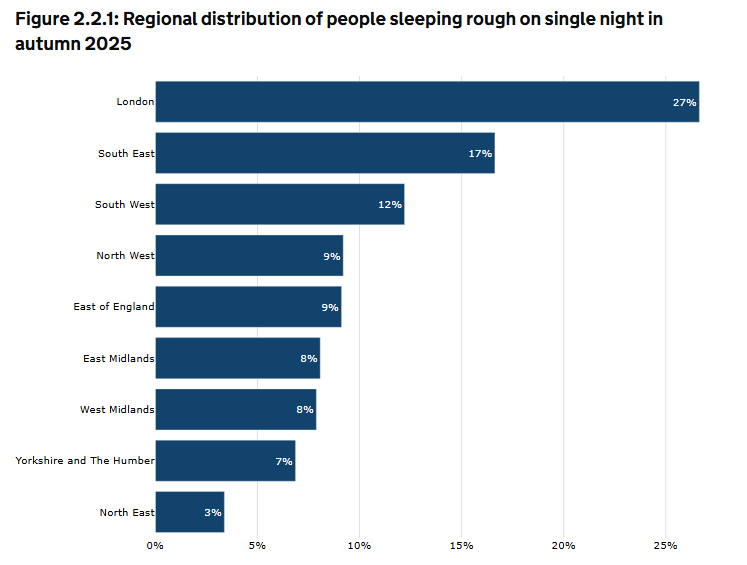
The North East figure is 3% of the rough sleepers across England, a total of 162 people in 2025 - that’s up 31% on 2024, the biggest increase in the country.
Newcastle was the local authority which saw the second-largest increase in the number of people - 46 in 2025, compared to 21 in 2024, so up 25.
As the ONS figures I link to above show, rough sleeping is mostly people aged over 26, mostly men (82%) and mostly UK nationals (65%).
It’s worth noting that ‘rough sleeping’ doesn’t mean homelessness in a broader sense - it doesn’t include those in shelters, temporary accomodation or sofa-surfing.
The official figures are also a snapshot for a single night, based on estimates and information from local agencies.
What I’m saying is, it’s not definitive, it’s just one aspect of the issue.
For a better sense of the scale of the wider issue, at the end of 2025, there were 134,000 households in temporary accommodation, including 176,000 children.
—
Solutions aren’t easy to come by - as with everything, if they were then we would have sorted it out long ago.
It’s fairly safe to assume what Andy Burnham is envisaging is versions of Greater Manchester’s A Bed Every Night scheme.
That’s what it sounds like, in that it was a big expansion of emergency accommodation provision, intended to catch people who would otherwise have become rough sleepers.
Here’s a write up of that from 2023, which talks about how it held down figures - but it’s worth noting while Greater Manchester’s rough sleeping figures were 60 or 70, there were 500 or 600 being supported by the A Bed Every Night initiative.
Local agencies - charities and the voluntary sector, alongside local authorities, housing associations, the NHS and the police - will know many of those who are on the brink of rough sleeping.
There will be almost constant conversations about how to access appropriate support for each individual, not least as there will often be trauma, mental health and substance issues running alongside the money and social support challenges.
I’m a firm believer in local approaches, not least because Greater Manchester is a condensed, mostly urban area of 3 million people in around 500 square miles, while the North East MSA is about 2 million in 3,000 square miles.
Although they had 24 different sites (in 2020 at least), this does allow Manchester a degree of centralisation of resources and assets for dealing with rough sleeping (and homelessness more generally), which just wouldn’t be appropriate in our region.
The BBC went out with outreach workers from Emmaus North East (I’ve mentioned them before) recently and went on more than 20 visits across Co. Durham, including to Spennymoor, Peterlee and Durham City.
Those are three very distinct places, and if you were scooped up in one and plonked in another it would take a lot of effort to get back - multiple buses at least - so we would need a vast number of small-scale emergency accommodation facilities and the teams to run them. You could probably name a dozen places in Co Durham alone where you’d want some emergency accommodation - as well as Durham City (where you’d want several), Peterlee and Spennymoor…how about Consett, Chester-le-Street, Bishop Auckland, Seaham, Newton Aycliffe, Stanley? How would you cover Weardale and the North Pennines?
Then start that whole process again for Northumberland.
It’ll need a uniquely North East approach, or rather many uniquely North East approaches to begin to dress it.
If you’re a student or educator, and you’ve got an educational institution email address, you can get an annual subscription to Wor Room for 20% off - that’s £40 a year, or £3.33 a week!
House Prices and Private Rents
The North East still has the fastest growing house prices in England, up 5.9% in the 12 months to May 2026.
Private rents (also linked above) have grown even faster, up 6.3% in the year to June 2026 - however the absolute figure, £781 per month on average, is the lowest of the English regions.
—
Also new out are some figures on housebuilding by local authority.
There were 8,310 new homes completed across the North East and Tees Valley local authorities in the 2025/26 financial year, and 9,280 more were started.
Co. Durham (1,550 completions) and Northumberland (1,450) led the way for completions in the region, but Newcastle really cracked on with new home starts with 2,730 up from 830 in 2024/25.
Workless Households
There were 164,000 workless households in the North East in the 2025 calendar year.
That’s 19.9% of working age households, which is well above the English average of 13.8%.
Hartlepool has the highest proportion of workless households in the wider region, with 23.9%, but Middlesbrough has the lowest proportion of working households with 45.2%.
There is a separate table which looks at the reasons for people not working, and interestingly while the North East does have a higher than average proportion of people who give being sick/disabled (40.0%) as the reason they aren’t working, it also has a high proportion who are studying (12.7%).
Both of those are above the English average (37.7% for sick/disabled, and 8.5% for studying), and the study figure is the highest in England outside of London.
Healthy life expectancy
There’s some new breakdown of healthy life expectancy figures nationally, going down to Middle layer Super Output Areas (MSOAs). Those are areas of 5000-15000 people, and although they don’t match local authority wards there are broadly the same number of them and they are around the same ballpark size.
Anyway, life expectancy - the new figures cover 2019-23, and shine a light on the disparities which often exist neighbourhood to neighbourhood.
Healthy life expectancy, the measure used here, is based on self-reported health and the time people spend where they consider themselves in good or very good general health.
For men for example, in England the average healthy life expectancy is 65.3 years in the figures, but there’s a spread of over 13 years between the bottom 10% (57.7 years) and the top 10% (71 years).
For women, the gap is wider - 58.6 years to 72.6 years.
The depth of the figures allows us to see, for example, that the men of North Gosforth have 70.5 years of healthy life expectancy, while those in neighbouring Longbenton have just 57.7 years.
See also, the women of Fulwell with 71.8 years of healthy life, compared to neighbouring Hylton Red House with just 55.9 years.
You can take a look at your area, using the interactive map on the ONS page.
The National Glass Centre
The National Glass Centre in Sunderland has closed for the final time, although wranglings over the future of the building and the facilities it housed are ongoing.
For a quick refresher on the story, check out this Guardian piece - but the long and short of it is the University of Sunderland believe it would cost £45m to renovate the building and it would be cheaper to demolish it.
The BBC’s ‘what’s next?’ article explains the plan for Sunderland Culture to take on the running of a new Glassworks in Sunnside in the city, and to provide interim facilities for makers - as well as grants and residencies.
The gallery element of the site is going to move to the new Culture House, which will be home to the City Library and various other civic things.
It’s a sad story for a building that’s not even 35 years old, and not especially in-keeping with the positivity which has generally been around Sunderland and its Riverside in the last few years.
Southpaw Dance seeks trustees
Southpaw Company are based at the Sheepfolds in Sunderland, and have a creative space for rehearsals, performances and community activites on the site.
They are an Arts Council National Portfolio Organisation, and run various engagement programmes, including ones aimed at children and young people and the professional development of working class artists.
Their Executive Director is Catherine Johns, who in an eclectic career has run Dance City, Kielder Observatory and was also involved in the development of NETPark and the region’s space cluster.
Southpaw are looking for three new trustees to join their board, one of whom will take over as chair in January 2027.
You can find out all about the roles here.
Vaccination rates
The BBC had an in-depth piece out yesterday looking at vaccination rates, and putting some of the decline in coverage we’ve seen in the last decade or so down to the difficulty in getting to clinics - particularly in the haze of looking after newborn or pre-school children. Essentially, it’s not complete refusal, it’s something having to give in the schedule.
This is actually one league table the North East is at the right end of, as the region does really quite well.
As a couple of examples, 81.5% of 15 month olds in the region have had their first dose of MMRV - compared to 78.7% across England - and 97.1% of 6 month olds in Northumberland have had their MenB second dose, nationally that’s 89%.
The target for all of these things is 95%, the reason being the threshold for herd immunity (remember that?) is about 93% for really contagious stuff like measles.
Tyneside teenagers speak up against misogyny
A final word for a project where a group of teenage girls from Tyneside created a video to shine a light on the mysogyny they face day-to-day.
The BBC have reported on the film, which was created with This Life Collective.
It’s on Instagram here:
Working with me
I’m booking stuff in for October currently, with odds and ends of free time between now and then.
To chat about projects, you can reach me on arlen@arlenpettitt.co.uk.
Well said Arlen. As octogenarians we have shared our lives with, and worked and campaigned alongside gay and trans all our adult life. The figure that stands out is that 20% of all crime is against women and girls and trans and gays are not to blame for that. Eliminating that awful statistic cannot be left to Government alone. It is the responsibility of everyone. 🐰