
The Good Stuff
Reflections on how - even with change - what's important and what's a priority don't always change

If politics is a TV drama, then last Thursday was definitely a season finale.
You know, like the episodes of ER where there’s a helicopter crash and a building collapse, and one of the senior doctors has a heart attack or something, all at the same time.
(Nationally, the new season of Politics kicks off today with the King’s Speech…classic TV writing. End with a bang, start with a bang.)
The scale of the change in the region’s local politics won’t have escaped any of you.
Back in January I did a session with academics at Newcastle University, looking at the year ahead. I included towards the end a slide with some predictions on what might happen in the local elections - of the five local authorities which were up for grabs, I called three right, underselling Reform in South Tyneside and calling Gateshead completely wrong.
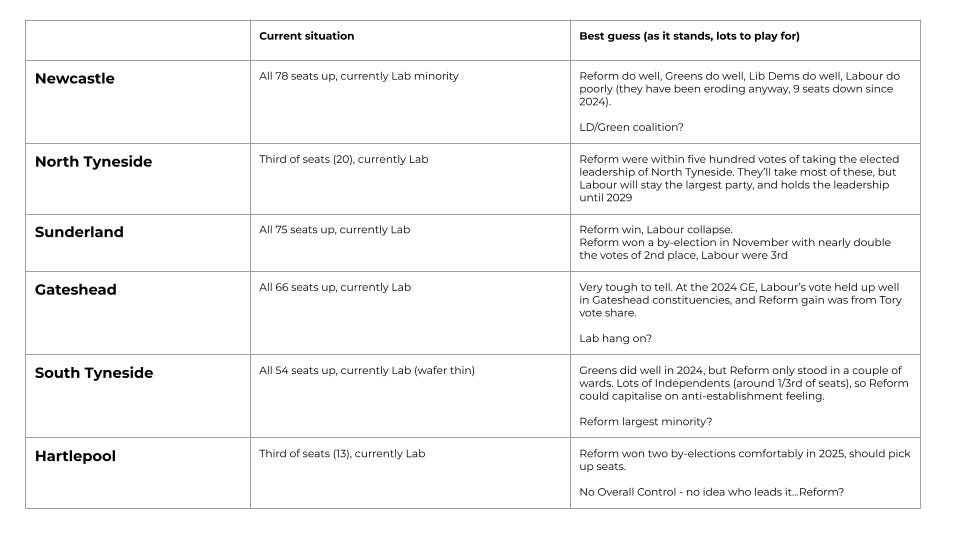
I’m particularly pleased with myself over my Newcastle prediction, as everyone looked at me weird when I said the Greens would do well.
Anyway, I’ll take 60% accuracy given how wild some of it was.
Four Labour council leaders not only lost their leadership, but lost their seats and we now have a clump of Reform-led councils in the region, with Gateshead, South Tyneside and Sunderland all joining Durham (which changed hands last year).
For Labour, it’s a generational change - councils which they’ve held since the 1970s have been lost, and councillors who’ve been in place since the 1980s have lost their jobs.
With that goes huge experience and institutional knowledge of the workings of local government.
That’s step one for the incoming administrations, whether Reform or Lib/Green, where the overwhelming majority of those elected will have little to no experience of how to run things.
It’s a steep learning curve even when you’ve got established colleagues, so it’ll be a huge, huge undertaking.
What’s going to change?
I’ve written a couple of times in the past few weeks for paid subscribers on reframing what you’re doing to fit shifting politics - first on protecting existing projects and programmes, and then on redefining your messages.
There’ll be more to come on that theme in future Wor Room EXTRAs, with the next one on approaches to briefing policymakers.
But, the main point I make in those pieces (an argument I mostly make above the paywall, if you want to check), is that the consensus is broken and we are all going to need to be far more thorough and regimented with how we talk about the issues which matter to us.
There are things - inward investment, urban regeneration, culture and the visitor economy all spring immediately to mind - where there has been broad agreement that these are Good Stuff and we should back those doing it and enable them however we can.
Lots of that is because for decades we’ve been making those arguments and the case for support has long-since been put to bed. The Good Stuff is good for a reason, but it’s been a while since we had to make a concerted effort on multiple fronts to demonstrate that.
Continuing my recent flow of Douglas Adams references, it is no longer enough to have the the case for your issue “on display in the bottom of a locked filing cabinet stuck in a disused lavatory with a sign on the door saying ‘Beware of the Leopard.”
Although I imagine that’s where the keys to some of the leaders’ offices are being left.
What’s not changing?
Jobs are still important. Skills are still vital. Opportunity is still the name of the game.
People still need homes. Businesses still need workspaces. The low carbon transition is still a chance for a new industrial landscape.
We need better health outcomes, better services and to tackle poverty and drive up employment and pay.
All of that was true when the polls opened on Thursday morning, and remains true now as the dust settles.
The Good Stuff is the Good Stuff - investment, business growth, culture and creativity, strong public services, and building on regional strengths.
The realities - the facts and figures - remains the same.
Economic inactivity of nearly a quarter of working age people.
Level 4 qualifications for fewer than 40% of people, when it’s close to 50% nationally.
Average pay of more than £2.00 per hour less.
Life expectancy two years behind the average for men, and a year and a half for women.
The most likely ot be overweight, or to be admitted to hospital as a result of alcohol-specific conditions or violent crime.
Quite the to-do list.
New council leaders
One of the things with the scale and pace of change in elected officials we’ve just seen, is that there’s not always an obvious person waiting to be the next leader of a council.
Where there’s an established group of councillors, and then they add a few more at a set of elections which takes them into majority, you sort of know who you are going to get.
We don’t have that for South Tyneside, Gateshead, Hartlepool or Newcastle (we don’t even know for sure what the governing coalition will look like for the last two).
We have just yesterday got that from Sunderland, as the Reform group there has chosen 30-year old financial adviser Chris Eynon as leader. He’ll then go on to be confirmed as leader of the council in the next week or so.
The other local authorities are on a similar timeline for the formal confirmation bit, so we’ll get some more of these announcements from the leadership groupings in the next few days.
More on alcohol
I just mentioned hospitalisation for alcohol-specific conditions above…the ONS also released new data this week on deaths as a result of alcohol-specific conditions.
The North East does the worst in England, with a rate of 21.1 deaths per 100,000 population. Across the UK, the average is 14.8, and London’s 10.9 is the lowest figure.
Nationally the rate amongst males is double that of females, and the North East is similar, with 26.4 for men and 16.2 for women.
Those figures are all for 2024, and on a local authority level there are three year aggregates available from 2022 to 2024.
South Tyneside has the highest rate in the region - 28.9 per 100,000 population - while County Durham is best with 20.2 and Stockton fractionally behind on 20.3.
It’s worth sharing a chart from the ONS publication to show the trend nationally.
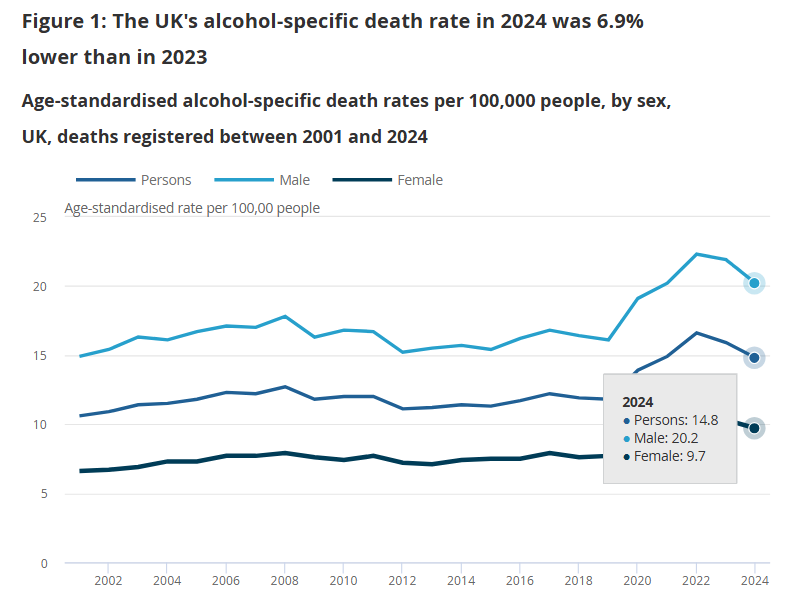
You can see it was sort of ticking along, and then boom - up it went - around the time of the pandemic.
Clearly, there’s a mental health aspect to this, and people were at home more away from support networks and with it harder to reach appropriate medical care.
It is coming back down, and that’s true regionally too where we’re still way above pre-2020 figures - which were about 15 deaths per 100,000 - but down from a peak of a couple of years ago which was about 25 or 26 per 100,000.
Foreign Direct Investment in the regions
If FDI is your thing, then you’re going to love looking at these stats.
They detail subnational FDI flows during 2024, including the proportion of the UK total which each region represents.
The main conclusion for the North East is we are around 1.0% of the national figure, both for inward and outward FDI.
Our flows of £20-something billion are tiny in comparison to the hundreds of billions elsewhere.
Durham Energy Manifesto
The transition to a low carbon and renewable energy economy is a big opportunity for the North East, and County Durham in particular.
A new Durham Energy Manifesto is being launched on 11th June, which is the outcome of a community-led project which brought together volunteers exploring the principles they’d like to the county’s energy transition.
The launch is being hosted at Redhills, and you can find all the details here.
Shipbuilding Museum
I liked this story from the BBC, on efforts to explore a museum in South Tyneside celebrating the region’s shipbuilding industry.
It’s a project being promoted by Jarrow shipbuilder’s daughter Bronwyn Mogie, and interestingly the initial planning is being carried out by Northumbria University’s Business Clinic.
A group of students will be doing the first explorations, and will set out a plan of action around the project and funding opportunities.
What am I up to this week?
I was out on a visit to a Newcastle fintech business this week, the first in a set of case studies in the city - hopefully I’ll be able to share those in the next few months
I had a trip to The Cluny for a Northern Music Export Office event, showcasing the creative collaborations built between this region and Japan by Generator and partners across the North
Writing a submission for a client to a call for suggestions from a Select Committee
Drafting a survey questionnaire as part of a research project
I’m at Helix Huddle this lunchtime, come and say hello if you’re there!
Thanks all - feel free to reach out on arlen@arlenpettitt.co.uk.